
Any lesson involving candy is a hit! Students love any activity where they can eat it afterwords, or in my case during!
This lesson follows the following Next Generation Science Standards:
5-PS1-2: Matter and Its Interactions – Measure and graph quantities to provide evidence that regardless of the type of change that occurs when heating, cooling, or mixing substances, the total weight of matter is conserved.
PS1. B: Chemical Reactions – Heating or cooling a substance may cause changes that can be observed. Sometimes these changes are reversible, sometimes they are not. (2-PS1-4)
This activity is super simple – all you need is a plate, hot water, and skittles!
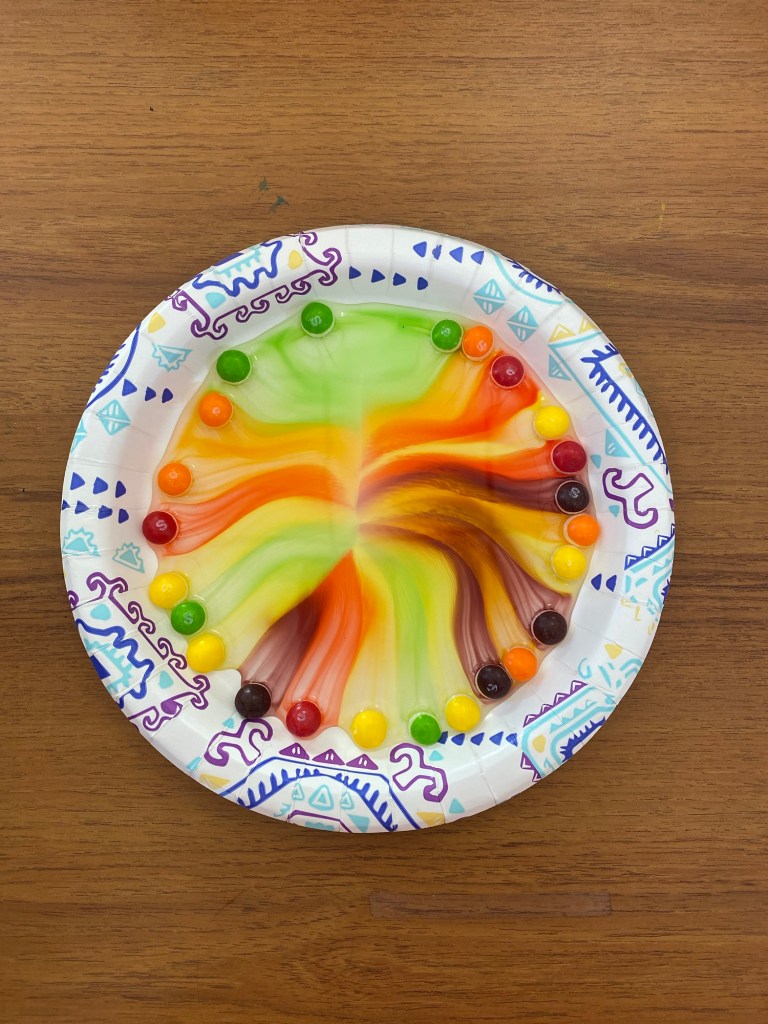
I got the largest bag of skittles I could find for this activity. Once I passed out paper plates I gave students a cup full of skittles for them to arrange on the edge of their plates. Once they added the hot water, the dye from the skittles blending into a beautiful visual! This is a great demonstration of diffusion in action. Diffusion is the movement of particles (sugar) from a space of higher concentration (the edge of the plate) to a point of lower concentration (the center of the plate). Warm water dissolves the dye (sugar) in the skittles faster than cold water – but make sure not to use hot water or it will melt and dissolve too quickly. Hot water will also prevent you from getting clean lines of dye separation in your results.
The lack of dye did not stop some of the kids from eating the skittles after the experiment, even though it changed the taste! Notice we’re missing a few skittles in the picture…
 HappilyTeaching
Leave a comment